by CrimePsych | Jan 27, 2020 | Blog
This is a long-standing debate amongst psychologists, criminologists, and sociologists. Some argue that when a person is born it is already determined that they will become a criminal. They suggest that some biological, physiological, or personality traits are already determined which will influence that person towards criminality.
Others argue that a child is born as a ‘tabula rasa’ which means blank slate. They argue that a child learns ways of behaving as they develop. They say that there are many different ways that a child learns as they grow and form an idea about how they should behave in the world.
The idea that criminals had distinct features was first proposed by Lombroso in the 1870s. He became convinced that criminals are an earlier evolutionary version of humans. He decided, after years of study, that you could tell a criminal by the shape of their face and the excessive length of their ape-like arms.
Lombroso suggested that criminals had distinct features such as large ears or an upturned nose. He suggested that thieves were more likely to have a flattened nose. Furthermore, he suggested that murderers are likely to have an aquiline nose like the beak of a bird of prey. Although this early work was quickly discredited, it was the beginning of investigations into whether criminals had distinct biological features such as different brain patterns to non-criminals.
The field was revolutionised in the 1980s by the invention of brain scanning devices. Professor Raine was amongst the first to investigate the brains of violent murderers. Raine and his colleagues scanned the brains of hundreds of murderers and found that they all had similar brain patterns. There was reduced activity in the pre-frontal cortex, the area of the brain which controls emotional impulses, and overactivation of the amygdala, the area which generates our emotions. This means that the brains were more prone to rage and anger. They are also less able to control their behaviour.
Raine found that all those who had this specific brain activation pattern suffered childhood abuse. It is possible that as a result of the abuse, the brain became damaged which results in more aggression. However, others pointed out that some people suffered abuse in childhood who did not go on to offend or be violent.
A breakthrough came in 1993 with a family in the Netherlands where all the men had a history of violence. Fifteen years of painstaking research revealed that they all lacked the same gene.
This gene produces an enzyme called MAOA, which regulates the levels of neurotransmitters involved in impulse control. If you lack the MAOA gene you are predisposed to violence. Whether the gene is triggered or not depends crucially on what happens to you in childhood.
So it seems that a genetic tendency towards violence, together with an abusive childhood, is a killer combination – murderers are both born and made.
One psychological theory that is used to explain criminality is Cognitive-Behavioural theory. This is based on the idea that cognitive processes influence thoughts and emotions. Psychologists such as Kohlberg and Piaget proposed that we learn levels of moral development. As we grow up we learn what is acceptable or unacceptable through socialisation. Kohlberg proposed that children follow a pattern of evolving and learning the various levels of moral reasoning throughout childhood. These stages are linked to the child’s age and ability to learn and reason.
Other psychological theories of crime look at individual factors, such as inadequate socialization and negative early childhood experiences, learned behaviours, personality and mental health disorders that can result in criminal thinking patterns. Psychological explanations of crime propose that a person’s thought processes and characteristic ways of dealing with the world can better explain criminality.
Psychodynamic or psychoanalytic theory is based on the work by Sigmund Freud. He suggested that we had 3 components which shaped our personality. We each have an Id, Ego, and Superego within our psychological makeup. The Id represents instinctual needs, the Ego represents understood social norms and the Superego is learned moral reasoning. According to psychodynamic theory, criminal and deviant behaviour are caused by imbalances between the Id, Ego and Superego. But it is almost impossible to measure and test each of these components to determine how they influence behaviour.
Learning theories suggest that actions are determined largely by life experiences. Learning theories suggest that we learn through ‘conditioning’. This means that when we perform a particular behaviour it can either bring about a positive or negative response. A positive response would result in a positive experience meaning the behaviour would be likely to be repeated. Behaviour may also bring about a negative response. This means that the person would have a negative experience and the behaviour is not likely to be repeated and avoided in future.
Other psychological theories suggest that a person’s personality, or some kind of psychiatric disorder, may contribute to the likelihood of engaging in criminal activities. Theories of psychopathy are popularly used to describe more serious and violent delinquent acts. However, the term psychopathy is not a medically recognised term. This personality type is more often referred to as Antisocial Personality Disorder within the medical community.
Other personality types have also been suggested to be linked to criminal and deviant behaviour. Eysenck’s Trait Personality theory suggests that we each develop certain traits and that we can be high or low on these traits. Eysenck found that soldiers’ answers in a controlled study seemed to link naturally with one trait or another, suggesting that there were several different personality traits which were being revealed by the soldier’s answers. Eysenck found that behaviour could be represented by three dimensions: Introversion / Extroversion (E); Neuroticism / Stability (N); Psychoticism (P).
Extraverts are sociable and crave excitement and change, and thus can become bored easily. They are more likely to take risks and be thrill-seekers. Whereas Introverts, on the other hand, lie at the other end of this scale, being quiet and reserved. They are already over-aroused and shun sensation and stimulation. Higher levels of Extroversion have been linked to criminality.
In conclusion, then, it is clear that there are many theories which can be used to explain criminality. Each of these theories has value in understanding behaviour and explores distinct aspects of behaviour, personality, and the environment. However, we are complex creatures who have biological tendencies and different personalities. We learn at different rates and in different ways and interact with our environment in different ways.
Taken individually, these theories of why people commit crimes cannot fully explain all types of crime and criminality. It is generally accepted that the environment, our biological makeup, and psychological factors all have a part to play in criminal behaviour. Therefore, several theories must be drawn upon to fully explain criminal and deviant behaviour.

by CrimePsych | Jan 20, 2020 | Blog
In this blog, I am going to give you an introduction to the psychology stalking. The definition given in a dictionary is to pursue or approach stealthily. However, this is a very simplistic explanation of stalking. The crown prosecution service defines stalking as repeated and unwanted attention which is unwanted by the victim and causes alarm or distress.
Stalking is legally defined as one offence. However, it incorporates a large number of possible behaviours that develop over time. For example, stalking may be threatening telephone calls, unwanted letters text messages or emails, unwanted gifts being sent, tracking movements, stealing personal property, threats of violence or intimidating behaviour. This can be with a person who is known to the victim or a stranger. It is more common for the perpetrator and victim to know each other, usually in an intimate way. For example, it may be an ex-partner and the emotional ties have been severed, particularly if this happens suddenly.
The most common behaviours in stalking are letters, emails, texts, and gifts. The offender may camp outside the house or workplace of the victim, make announcements about them, spread rumours about them, or destroy their property. In extreme cases, stalking can lead to threats of violence or even rape, assault and murder.
The type of relationship can vary from complete strangers to being well known. Some researchers have focused on classifying such relationships. Where the perpetrator is a stranger, there is usually some pseudo intimate relationship between them. Even when they are strangers, there will be some connection between then in the offender’s mind. The offender may blame a victim for a loss or failure of some kind. The victim may be in the public eye and the offender has developed an imagined relationship with them. Stalkers are mostly male, however, females can also be stalkers.
Because of the diverse nature of stalking, much of the research in this area has been directed towards classifying stalking behaviours and stalking scenarios. Once the various classifications exist, it may then be possible to design interventions and rehabilitation programs for stalkers.
Some researchers have focused on the relationship between the victim and the perpetrator. This is the level and type of interpersonal relationship between them. A researcher named Richie proposed one such classification system in 1994. He suggested that the relationships between stalker and victim could be classified as celebrity stalking, acquaintance stalking, and ex-partner stalking. However, this is a fairly simplistic classification system that excludes some stalkers. For example, what if the stalker had mental health problems, what if the stalker was a stranger and the victim was not a celebrity? Also, what if the stalker was a work colleague?
Other classifications of stalkers also exist and they can focus on various aspects of the stalking. For example, some focus on the relationship between the victim and the perpetrator. Others focus on the psychiatric and mental state of the offender. Some focus on the context of the stalking behaviours and others on the rehabilitation of stalkers. This can be neatly summarised into two classifications: The interpersonal relationship and the nature of the contact between victim and perpetrator.
A classification of stalkers by Harmon and colleagues in 1995 suggested that the stalking behaviour will be either ‘affectionate/amorous’ interactions or ‘persecutory/angry’ interactions. In 1992 Some researchers have defined stalking behaviour in terms of the level of intimacy, or at least level of sought intimacy. Some stalkers are ultimately seeking sexual contact with their victim. Other stalkers may be looking for revenge of some kind. Whilst all of the different research areas being important in their field, it would be more helpful if a theory could focus on all aspects of the relationship between victim and perpetrator.
Canter and Ioannou proposed a comprehensive model of stalkers in 2004. They proposed that rather than being distinct categories, stalking interactions and type existed on a continuum. They suggested that a stalker would see and treat their victims as either an object, a person, or a vehicle.
When the victim is seen as an object, the main objective is control. This is possessive behaviours in which the offender assumes to have ownership of and can control using their various behaviours and interactions. This would include acts such as repeatedly driving past the victim’s workplace, the offender contacting the victim after a restraining order has been put into place, contact with the victim’s family which can become aggressive. This also includes threats and confrontations, or even physical attacks on the victim. The offender would have a complete lack of empathy for the victim. The main characteristic of this style of stalking would be aggression.
When the victim is seen as a vehicle, the main characteristic would be contact, which is sexual. This would be evident in behaviours such as asking to meet, entering the victim’s house, stealing or destroying personal property. The offender is simply using the victim to express his or her desires or anger.
The final category is the victim as a person. As the label indicates, the offender takes an interest in the overall life of the victim. They would research them in various aspects of their life. They may even follow the victim or plant surveillance devices to track their movements. All of these behaviours are an attempt to reduce the level of distance between them both and create a higher level of intimacy. This can be seen as an attempt to form a somewhat normal relationship between the victim and the offender by ‘stealing’ the information and forcing the relationship.
All three of these categories can range from a little to a lot. The level of stalking behaviour depends on the offender. The next stage to this research would be to determine the likely characteristics and relationship between victim and offender. This framework could also form the basis of a rehabilitation program which focuses on building appropriate interpersonal relationships.
However, if I was being stalked I would not be interested in knowing whether the offender saw me as an object, vehicle or person. I would be more interested in knowing what I could do to stop it. The first and most important piece of advice I can give you is to not engage in contact in any form. Even if you were to react violently or emotionally, that is what the offender wants. They want to engage with you and have your attention. Every time you shout leave me alone down the phone or change your habits, it is what the offender is looking for.
Let’s say someone has sent you two letters, and two texts, and left a present at your door and you didn’t want it. That in itself may not be enough for the police to arrest and prosecute them. The main criteria for the police to act is by someone being in fear of their or someone else’s life. In the beginning, you might think that this unwanted contact is a one-off and will stop once they get bored. But they might not get bored. Document everything in as much detail as you can. Keep as much evidence as you can, including keeping texts, emails and photographs, friends accounts as corroboration. All of this evidence will be very valuable should it ever be taken to court.
Never put yourself in danger in gathering evidence though. I’m not suggesting you march outside and take a photo from close to the driver’s window. If you are worried that someone may be stalking you, keep your phone on you at all times. Let people know where you will be and when and tell them what they should do if you don’t turn up. Report each instance to the police and keep a journal of activities. And never engage with the stalker, even if it is negatively. Any contact with you will be seen as positive by them.

by CrimePsych | Jan 13, 2020 | Blog
There are several disciplines which have proposed the reasons for crime and criminality; these include Sociology, Criminology, and Psychology. Even within these disciplines, there are a variety of theories of crime.
Crime is viewed as a deviation from the social norms within a society. There have been multiple proposals of why some people break the law while others do not. Factors such as age, personality, moral development, gender, attitude, adolescent, personality disorders and upbringing have all shown that they can influence a person’s behaviour. These can be classed into three broad explanations of crime: Biological; Psychological; and Social.
So which one is right? Can we say with 100% accuracy that criminals are either born or made? The simple answer is no, we can never be 100% certain. Each and every theory of crime begins with an experiment or test of some kind. Scientists usually collect data analyse it then make general assumptions about how well we can predict the phenomenon again.
On order to fully explain why each of theories is correct in their own right, I will need to explain the basic research framework. This is a very simplistic explanation just to give you an understanding of the stages in research.
A researcher begins with a question or a problem that requires a solution or explanation. They form their hypothesis, in other words, what they expect to happen or find. They first or all need to decide what type of data they are going to use in their research. When examining crime or criminal behaviour it may be unscripted interviews with offenders, police arrest records, conviction records, carefully worded questionnaires and so on. Then that data is put into a computer program and analysed using complex statistics which will show what can be statistically proven and what cannot be proved.
Then a research paper is written and sent to a journal and is reviewed by several experts in their field. If the experts agree with the findings of the paper it is published. Many different studies put together over time form theories of crime. So one research paper might examine 200 UK offenders and show their findings. Then it is repeated with 200 European offenders or any other group of offenders and supports the original findings.
Over time, every single theory of crime has been proven several times with various participants. Each of these is correct and right in its own right. Researchers may argue amongst each other about the various weaknesses of the data or analysis or conclusions drawn and this is why there are several theories of crime.
The starting point for each explanation of crime is so varied. One group of researchers may start with looking at brain activation patterns in violent offenders and find the same activation patterns in most. Another might look at personality characteristics of violent offenders and find a particular trait is evident in most. Just because one is right doesn’t make the other one wrong – the simply had different research patterns and focuses.
by CrimePsych | Jan 6, 2020 | Blog
Many of my blogs and videos are written from the perspective of a criminal psychologist. As a researcher, I want to examine crime and criminal behaviour so I can understand or explain behaviour. Much of this is done by conducting large scale studies and categorising behaviour in various ways. Some of the work involves working out what the likely characteristics of offenders are.
I have said on many occasions in the past that criminals are not a unique subset of individuals. They are amongst us. They are our brothers and sisters, mothers and fathers and so on. I have also said that we need to focus on the actual behaviours and interactions between victims and offenders to understand the psychology of it. However, a researcher named Jack Katz proposes a very different theory of how we should examine crime.
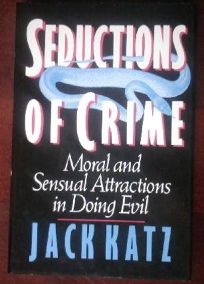
Katz wrote a book called the seductions of crime in 1988. It was and still is, seen as a fairly controversial view of criminality. Katz begins the book by asking the reader to reflect on the reasons they act in the way that they do, what propels them to act in certain ways in various contexts? He suggests it comes down to motivation. The invisible forces that attract us to interact or repel us away from interactions. For example, I went to visit my mother because I hadn’t seen her for a while. The underlying motivation to that is I wanted to make her happy which in turn made me happy and resulted in a pleasurable experience.
Similarly, I avoided going to the shops on Christmas eve because I knew it would be really busy and people might be bumping into one another and there wouldn’t be much left anyway. The underlying motivation here would be that I wanted to avoid an unpleasant stimulus by not going. This is the same reason I would not go and get involved in a fight.
Standard theories in criminology and psychology have attributed certain characteristics to offenders. For example, they come from a disadvantaged background, they were abused when they were younger, they have learned to react violently. However, if these are the only factors that cause criminality, then why are these people not committing crime every single minute of every single day? Katz suggests that there must be some underlying force that propels them to act when they do.
To put it simply, Katz suggests that offenders act ‘because they like it’. When talking about property crimes such as vandalism and burglary, Katz calls it the ‘Sneaky Thrill’. He suggests that these property crimes appeal to young offenders independent of the material gains that are made. One particular example he uses is of two young boys aged 14 and 16 driving around and spotting a pizza delivery driver. The older one said it would be so easy to steal those pizzas and they took them. They told how they spent no time thinking about it or discussing it, they weren’t even hungry but enjoyed the pizza because of the way they had got it.
There are countless examples of crimes being committed because of enjoyment. Often young people will break into a property and take items which are of little or no use to them. These items are sometimes discarded and are sometimes kept as souvenirs. They didn’t break in and take the goods because they wanted them or needed them, they simply broke in because it was exciting and stimulating.
Think of when you were a child and one of your parents told you that you were not allowed a particular treat. If the other parent sneaks it to you and says you can have it, it normally tastes so much better because you were told you couldn’t have it.
I have spoken in the past about the escalation in violence in serial killers. At first, only a minor act would be enough to cause excitement. For example, if a murderer strangled a victim to death they may find it highly stimulating and they would produce high levels of adrenaline. As the offender kills more victims, he needs a higher level of stimulation to get the same level of adrenaline and might be more violent with the victim.
The view that offenders commit crimes because of the excitement or enjoyment they gain from it may be controversial. However, it is understandable that please can drive people to act in this way. In the same way that pleasure can sometimes drive criminal behaviour, so to can the avoidance of negative consequences. Young people who vandalise or break into properties may be avoiding being bored.
I have seen this behaviour from a very personal point of view. I once knew a fairly wealthy middle-aged woman who used to go and do her shopping and steal some of it. She paid for some items and stole others. She used to tell me that she found it very exciting and it wasn’t about the items that she stole, but about the excitement and the fear of getting caught.
In a large scale study that I conducted with the general public some years back, one of the items on the questionnaire was ‘have you ever had sex outdoors?’ People often scored the highest on this particular item. I discovered that 68% of 225 people had sex outdoors on at least one occasion. Again, this is likely to be because of the excitement of getting caught.
In conclusion, I do not think that people commit crimes solely based on gaining pleasure or avoiding negative impacts. However, I do think that it can explain some of the motivating factors to offending. Obviously, most of us live by social norms and limit the things we do because they are against the law. Some people are more likely to live by social norms and follow the law than others. I believe the pleasurable aspects of offending certainly influence some individuals.

by CrimePsych | Dec 30, 2019 | Blog
Violence can occur in many ways under a variety of circumstances. Violence can have a huge impact on a wide variety of people. The act of violence stems from the emotion of anger. Everyone experiences a range of emotions from happy and excited to sad and angry, it is part of our biological makeup. However, when the emotion causes us to behave in anti-social ways, we need to understand what drives it and how we can intervene to reduce or prevent it.
The act of violence can be a range of behaviours which stem from emotions and reactions to various stimuli. Psychologists have suggested that acts of violence can be explained as being an extreme response to a normal emotion. This can happen with a range of emotions. For example, everyone feels sad at times but only some develop depression. We all feel angry at times but not everyone resorts to aggression.
However, it is not as simple as this. Because if this were the case, then anger management programs would be 100% effective and they aren’t.
Anger may play an important role in violent behaviour for some. However, it is not necessary or sufficient on its own to cause violence. Other factors such as drug use and mental health problems have been linked to acts of violence. However, there is little evidence to suggest that these things cause violent behaviour. For example, fights at football matches can occur between rival fans, but some people have no interest in the team that attend matches so they can be a part of the violence. They are not angry at the time, not all will be on drugs or have mental health issues. They simply enjoy being violent.
It is unsurprising then, that rehabilitation programs and anger management programs are not 100% effective. Research has established that the most accurate predictors of violent behaviour are gender, age, and a history of involvement in violent acts.
Psychological research has established that there are two types of aggression: Instrumental or Expressive. It was Feshbach who coined these terms in his studies of aggression. Feshbach suggested that Instrumental aggression is defined as the violent act being carried out as a means of achieving something or getting an item. For example, if a thief punched a shopkeeper in the face to steal money from the till or goods, then the act was carried out so that they could achieve another aim. Alternatively, Expressive aggression is driven by emotion and the violent act is carried out as an emotional reaction. For example, if someone batters their partner because they are angry then the violence was the main aim of the act.
Several theories within psychology suggest that we learn how to behave through our experiences. By learning throughout our lives, we develop ways of interpreting and understanding the world and social processes. We have learned things as a young child such as our mother will protect us and feed us. As we grow we learn the positive and negative consequences of our actions. For example, a child might learn that if we kick the dog, their toys are taken away as a punishment or they get shouted at. The same principle can be applied to violence. For example, a person may have learned that when they feel angry and are aggressive to someone it makes the feeling go away. They might learn that if they need money or want an item, they just have to use violence on a person to get it.
This process can be highly dependent on the individual contexts people come into contact with. However, some research has begun to explore what factors can trigger acts of violence. Research with high-risk, violent offenders indicates that low self-esteem, developed from a young age, can play a key role in triggering violent behaviour. For example, a person may have a negative view of themselves and have low self-esteem following a difficult, traumatic, abusive or neglectful childhood. This person may appear confident, even arrogant to other people. Researchers suggest that this is a defence against inward feelings of shame, weakness, vulnerability and inadequacy.
The research in this area has suggested that these feelings are so painful, that if the individual perceives that someone humiliates them or shows them disrespect, they are unable to tolerate it. A violent response restores a sense of self-worth and pride, while also punishing whoever caused that sense of injury or humiliation. It is not yet well established whether this assumption is true across a range of offenders, however, early indicators are hopeful.
As well as psychological explanations of violence, biological explanations also exist. Early in our evolution, violence and aggression have been important in keeping us safe and killing prey to eat. If a person shoots a man, it is a violent crime. However, if a hunter shoots an animal it is survival. It is the same act of shooting. As a species, we have developed a fight or flight response. Our brain shuts down normal functions and reverts to using the sympathetic nervous system. It happens very fast and is beyond our conscious control. We get massive doses of adrenaline and noradrenaline which change our body to prepare to fight for your life. Therefore, if a person feels threatened by real or imagined people, places, or things the automatic process takes over and can result in violence.
Hormones have also previously been suggested to increased acts of violence. Specifically, the hormone testosterone. However, research in this area now accepts that it is not testosterone in isolation that triggers aggression. Increased levels of testosterone have an impact on the amygdala, hypothalamus and periaqueductal grey and can increase aggression levels.
In conclusion, then, research in different areas has shown that several factors can increase aggression and as such impact on violent behaviour. However, it is most likely that aggression and violence are the results of an amalgamation of factors creating the ‘perfect storm’.

by CrimePsych | Dec 16, 2019 | Blog
It is no surprise that Christmas can be either the most wonderful time of the year or the worst time of the year. Sometimes it is both. Everybody is different and so will have a variety of things that can either delight or dread you. I personally do not think that one size fits all when giving out advice on wellbeing over the Christmas period. You may be someone who is stressing about getting your home looking perfect for social gatherings, you may be a single parent who has no money, you may have lost someone special, you may be the victim of domestic abuse, and you may be someone who struggles with anxiety or other mental health problem. Whatever your situation is, you need to look after yourself and do what is right for you. Not all of these suggestions on wellbeing are going to apply to you. The main theme running throughout all of this advice is: be honest with yourself and other people, and do what is right for you.
1. Plan ahead. Christmas is a busy time of the year and it is important to plan ahead. Buying presents throughout the year can help to reduce the financial pressure and can help save you time too. It is also important to plan your time. It is easy to say yes to too many social invites for fear of hurting people’s feelings. Keeping events on a calendar can help to make sure you don’t overdo things. Remember that it is ok to say no to people. It is possible to do this without hurting anyone’s feelings by saying things such as ‘thank you so much for inviting me but I am not going to able to make it. I have already agreed to (x, y, z) but I will come to your next party/dinner if I can’. Try to mark off a day or two that you don’t have to go anywhere and take some time for yourself. It is easy to become overwhelmed.
2. Avoid comparisons. Most people have a social media account and compare themselves to others. Even before social media was around we had the term ‘keeping up with the Jones’. We see things that other people have and want it for ourselves, it is natural. However, you must remember that what you see in a picture doesn’t always represent the truth. Susan may well have put a picture up of her beautiful family and her pristine home, saying how much she loves the expensive gift her husband bought her. But what you don’t see is the amount of debt that they are in, or the mess the other side of the camera, or the bruises she has because of her husband drinking too much and becoming violent. It is ok to have a different type of home life or less money than the next person, we are all unique. You are doing the best that you can within your means. As long as your situation makes you happy then others can do what they please.
3. Have an escape plan. During this time of year, families tend to visit and stay with each other and you find yourself having to bite your tongue or count to ten. Everybody, whether they are related or not, can do or say things that upset us. I am sure we have all heard of the stereotypical mother in law who visits at Christmas and takes over, criticizes, nags and moans. There may be that one aunty or uncle nobody likes because they drink too much or are rude. First of all, try not to react as this can make situations worse sometimes. Plan ahead to think of things you can do or places where you can go if you need a quiet half an hour or so. Maybe put some headphones on, go for a walk, go and sit on the loo for 10 minutes – do whatever you need to do so that you can calmly go back and respond to needs, questions, demands or suggestions about how you could run your home better!
4. Moderate food and alcohol intake. While a bit of alcohol can make you feel relaxed, don’t forget that drinking too much can leave you feeling irritable and low. Drinking within the recommended guidelines means you’ll get to enjoy a Christmas tipple, whilst reducing the negative effects on your mood. Alcohol can also play a big part in arguments and disagreements, so it’s sensible to drink in moderation. Alcohol can also fuel aggression. For those who are experiencing domestic abuse, their partner can become more violent after alcohol. If you are in this position you obviously have no control over how much your spouse, I’m sure you would not want to say anything to them anyway in fear of a violent reaction. However, you can moderate your own alcohol intake so you can make decisions on how to keep yourself safe. To some people, Christmas is all about the food. However, eating too much sugary or fatty food may leave you feeling lethargic and irritable. You (or the host) may want to please people by offering too much food, but if someone says no thank you, you should respect their decision and not keep offering until they say yes. Similarly, if someone insists you accept food you do not want, remember it is ok to politely but firmly say no thank you.
5. Mix and socialise with people, or don’t. There is a lot of pressure to not be alone at Christmas time. However, you can be in a room full of people and still feel alone. It is nice to be asked and invited to be included, but if you would prefer to be alone then you should. Whatever you do, it should be because you want to do it, not because you don’t want someone else to feel bad. One phrase that I particularly like is ‘if it involves fake smiling, I’m not going’. If you would prefer to not be alone, seek out other people to be with, ask them. You might come up with a list of excuses why people wouldn’t want you there at Christmas, but that is you doing other people’s thinking for them. You might not want to be a burden, but if people really didn’t want you there they wouldn’t invite you. There are also lots of community projects that bring people together who would otherwise be alone over Christmas.
6. Be aware of your own needs and mental health. Depression can mean that you have no desire to be included in other people’s activities. Anxiety can mean you feel sick at the thought of having to be in a room full of people. Depression and anxiety can come in waves, so talk with someone you trust beforehand about how you are going to manage any situation that pops up over Christmas. Sometimes we do need that bit of encouragement to get out and enjoy time with others. I have been to parties and dinners that I really didn’t want to go to and by the end of it am glad I went. Every person is going to be different and has different needs, but do try and discuss it with someone you trust beforehand. Do things that you know you like doing and do not allow others to make you feel guilty for your choices. Conditions such as Tourette’s, autism, and ADHD can make social interactions feel more daunting. If you or someone you love has any condition that requires additional needs and you are visiting friends or family, give them a call beforehand to discuss your needs. Simple measures can make a lot of difference to various conditions. Making a quiet place available, taking ear defenders, having an outside space available, knowing what to expect and planning ahead matters. Be clear on your needs and letting other people know can greatly reduce stress.
7. It is ok to grieve. This may be your first Christmas without a child, parent or other loved one, or it may be your 30th. You never get over losing someone you love, but the weight of grief can get easier to carry over time. I cannot even begin to imagine the pain of losing a child; I think the only ones who really know are those who have been through it. Whether it is a child, parent, grandparent, spouse, sibling or any loved one you should not hide your grief. Talking about it is really difficult at first, but it gets easier the more you do it. You can get specialist help and advice, but you can also encourage other people to just remember the person and talk about them. Set a place at the dinner table in their honour, talk about your memories, talk about special times like birthdays or previous Christmases, or talk about how much it hurts. Keeping it in and not talking about your feelings will not make them go away. Others may not know how to bring up the subject or maybe too scared to say their name in case they upset you. You can cry, laugh, frown, smile, or do whatever it is that comes naturally, you do not need to feel guilty if something makes you laugh. Tell other people what you are feeling and what you are thinking, they will probably be relieved that you did.
8. It is ok to have no money. Who says you need expensive gifts to be happy at Christmas? It is a time to get together with your family, not a time to go into debt to make them happy. If you cannot afford gifts, then the gift of being together is enough. We live in a consumerist society that expects us to spend every penny we have on Christmas. Who are we really making happy with all these gifts? Our family or the shops that now have your money? Why not agree with everyone that you will do something other than buying gifts? Activities such as a gratitude list are a lovely idea. Write your family member a letter telling them how much you love and value them. Or a list/letter saying what you have enjoyed most with them over the last year? I am baking my family biscuits and cakes this year. They know my time is the most valuable asset I have, so they know me taking the time out to bake for them is the nicest gift I can give them.
9. It is ok to be single. Being single myself, I see the pressures that society puts on people to find love at Christmas. The adverts all portray loved up couples in front of the fire. The films all show two people falling hopelessly in love after some tragic event or misguided adventure. What a load of nonsense. I can be happy and not be in a relationship this Christmas. But I know that some people worry about this or think they don’t get invited to places because they aren’t a couple like their friends. In reality, there is probably some other reason they weren’t invited. I have known people to get a boyfriend/girlfriend for just over the Christmas period. What we really need to change is peoples idea that you can’t be happy alone because you can. I have one aunt who always asks me why I’m single or when I’m going to find ‘the one’. She tilts her head to one side and has a sad look on her face. But what is really sad is staying in a relationship that you are not valued in. Living with someone who abuses you physically or mentally is much more harmful than being alone. If you are single this Christmas then you are in a far more fortunate position than someone who is beaten on a daily basis or constantly told they are not worthy. Nobody needs another person to complete them, you are already enough on your own. If you feel alone, you could try volunteering work. It is a great way to meet new friends and give something back.
10. Be healthy if that’s what you want. If you choose not to drink alcohol or to eat healthily over Christmas you are likely to be seen as the ‘odd one out’. However, there is no rule book to say you must eat and drink too much, do what you want to do to stay happy and healthy. You may be visiting friends or family and not able to go to your normal gym. However, there are lots of alternative ways to keep up your fitness. Stairs anywhere are a really good place for exercises. Get outside and go for a brisk walk to get your heart rate up. Being in the same house for too long can get a bit intense, especially if it’s crowded, so a change of scenery will do everyone good! Don’t feel pressured to give in to other people if you don’t want to. Your needs are just as important as other peoples.
If you’re worried about Christmas or feel overwhelmed or under pressure, don’t be afraid to talk to someone about it. If you are feeling overwhelmed or under pressure, talk to someone about it. If you are worried about how you might feel on the day, talk to someone else who will be there too so they can support you when needed during the festivities. There are lots of resources online to give you more ideas about staying happy and healthy over Christmas.


