
by CrimePsych | May 18, 2020 | Blog
In the earlier blogs that I have done. I have discussed some of the various uses and techniques used to understand the psychology of crime in general. In this next series of blogs, I am going to discuss some specific offence types.
In some of the earlier blogs that I have written, I have written about the differences between the way the police examine offending and how psychologists do. The police focus on offence types that can be prosecuted. These give clear meaning and clarity to the law or laws that the offender has broken. However, psychologists must focus beyond the label of the crime.
As this blog is discussing arson, here is a hypothetical example of the difficulties psychologists face when only using labels of crime:
Joe Blogs was arrested at 2 am outside his workplace on April 1st 2020. He was found to have a canister of petrol, a box of matches and the keys to the building on is person. The workplace was on fire and destroyed by the blaze.
When the police look at this offence, it is simply categorised as arson. However, from a psychological point of view, it is a very broad category. There are too many unknown variables and we need further information. Joe Blogs might just enjoy setting fire to buildings and watching. He may have been seeking revenge for something. He may have robbed the place and set it alight to destroy any evidence.
Criminal and Investigative psychologists must think about, and examine, crime according to the behaviours which are carried out by the offender rather than the label of the crime. A man who burns a building down for pleasure is psychologically very different to a man who sets it alight for enjoyment. Therefore, one category of crime cannot differentiate between arsonists. However, it is still possible to draw some general conclusions about arsonists overall.
In general, arsonists are a fairly distinctive group of offenders. Fritzon, Lewis and Doley (2011) found that the majority of young arsonists are part of severely disrupted family environments. They found that young arsonists had experienced parental separation, illegitimacy, death of a close family member, or brought up in a children’s home.
Several researchers have found that arsonists are not likely to be conventionalist. They are most likely to have several convictions for property crimes and had spent a significantly longer time in institutions before the age of 14 than other types of offenders. They are also likely to be less intelligent and less attractive than other types of offenders (Hurley & Monahan, 1969; Rice & Harris, 1991).
The target of the fire is an important factor to consider. An arsonist may intentionally target building or places where they know there are not likely to be many people. Others may be focusing their intention on harming people. Some researchers have described arson as being focused on objects (Hill, Langevin, Paitich, Handy, Russon & Wilkinson, 1982) or people (Barnett, 1992; Lewis & Yarnell, 1951). They also found that arson had been defined as having a retaliatory as well as a non-retaliatory response (Pettiway, 1987). Other studies into arson have suggested that offenders had set the fires for some internal gratification. Whereas some had suggested that offenders would set the fire or external gain such as destroying evidence (Geller, 1992; Pettiway (1987); Sakheim, Osborn & Abrams, 1991; Feshbach, 1964).
Therefore, Canter & Fritzon (1998) designed a study to determine the psychological aspects of arson. They gathered police records of 175 solved arson cases where the offender had been convicted. The contents were examined by taking information from police and court records, interviews, and witness statements.
Canter & Fritzon found that the behaviours within arson could be identified as being targeted towards an object or a person. The Object category includes behaviours such as the fire being committed in public, theft of objects/goods, or materials being brought to the crime scene. The Person category includes behaviours which suggested that the person was of most significance to the offender at the time of the offence. This included variables such as threats made, arguments with others, or a suicide note is written.
They also found that the behaviours could be defined as being set for internal or external gains. The internal gain category means that the fire was set for a gain which was internal to the offender. This would include aspects such as the fire being set for revenge, enjoyment, or carried out at their own home. These were labelled Expressive gains. The external gains category reflects behaviours which are not emotional. These external gains would be behaviours such as theft or to conceal evidence. They labelled these Instrumental gains.
This allowed the researchers to say that there are 4 classifications of behaviour in arson. Instrumental Object would mean that the arson was carried out for an external gain and an object was targeted. Expressive Object would mean that the gain was internal to the offender and an object was targeted. Instrumental Person means that the gain was external to the offender and a person was targeted. Finally, Expressive Person means that the gain is internal to the offender and a person was targeted.
In-depth research such as allows one offence type to be differentiated according to various psychological components. Breaking down arson into these subcategories has meant that researchers can determine the most likely characteristics of offenders. Canter & Fritzon then went on to examine which types of individuals are most likely to carry out which set of behaviours. I have included a link to this research article below.
References
Barnett, W. (1992). Psychology and psychopathology of firesetting 1955-1991-A review. Fortschritte
Canter, D. & Fritzon, K. (1998) Differentiating arsonists: A model of firesetting actions and characteristics. Legal and Criminological Psychology, 3, 78-96.
Fesbach, S. (1964). The function of aggression and the regulation of aggressive drive. Psychological Psychiatry, 1, 185-212.
Fritzon, K., Lewis, H., & Doley, R. (2011) Looking at the characteristics of adult arsonists from a narrative perspective. Psychiatry, Psychology and Law, 19(3), 424-38.
Geller, J. L. (1992). Communicative arson. Hospital and Community Psychiatry, 43, 76-77.
Harris, G.T., Rice, M.E. & Cormier, C.A. (1991) Psychopathy and violent recidivism. Law Hum Behav 15, 625–637.
Hill, R., Langevin, R., Paitich, D., Handy, L., Russon, A. & Wilkinson, L. (1982). Is arson an aggressive act or a property offence? A controlled study of psychiatric referrals. Canadian Journal of Psychiatry, 27, 648-654.
Hurley, W. & Monahan, T. M., 1969) Arson: The criminal and the crime Hurley, TM Monahan Brit. J. Criminology 4-16
Lewis, N. D. C. & Yarnell, H. (1951). Pathological firesetting (pyromania). In R. G. Vreeland and M. B. Walker (1978) (Eds), The Psychology of Firesetting A Review and Appraisal (National Bureau of Standards, grant no. 7-9021). Washington, DC: US Government Printing Office, 1980.
Pettiway, L. E. (1987). Arson for revenge: The role of environmental situation, age, sex and race. Journal of Quantitative Criminology, 3, 169-1 84.
Sakheim, G. A., Osborn, E. & Abrams, D. (1991). Toward a clearer differentiation of high-risk from low-risk firesetters. Child Welfare, 70, 489-503.
Photograph by Rowan Freeman https://unsplash.com/photos/QEXRDPjAAfk

by CrimePsych | Apr 1, 2020 | Blog
This is not the usual type of blog that I write as it is not about crime. However, as a psychologist I recognise that these are unprecedented times. The whole of the UK is on lockdown due to the corona virus and this may have an impact on the nations mental health.
As we know, all the schools, colleges and universities in the UK are now shut meaning that the children are home at the moment. I have seen a range of social media posts about how well (or not) parents are coping.
There are some very real challenges in navigating your way around everyone being at home. You may have to work from home yourself. You may have several children of different ages who all require a different type of work and attention. I have seen lots of posts about homeschooling and the various activities they have created. However, I have also seen some posts from teachers encouraging parents not to try and home school their children.
I have spent a long time on the government website to look for the requirements of home-schooling and the advice is unclear. For younger children, there does not appear to be any legal requirement for a parent to deliver education from home. Some older children may be required to complete online assignments set by their schools and colleges. However, there is no guidance on whether or not parents should be delivering extra classes or education.
My son is currently doing his A levels. I took A level maths and somehow managed to pass. However, I know I would be useless if I was required to try and teach him any of that. If I was asked to educate my child on high school history or French, I wouldn’t have a clue! So, could we be doing more damage to our children by insisting that they take part in educational activities at home? There are some parents with an infant and junior school-aged child that would be lost on several different subjects.
We, as parents, are trying to do the best that we can for our children. It is good to keep a sense of normality in their lives during this uncertain time. Trying to stick to some kind of normal behaviour pattern can be a very helpful thing to do during isolation. However, hundreds of people are putting more stress on themselves and their children by forcing them to do this.
Some parents are causing themselves an immense amount of stress by trying to work full time from home, educate their children, and take care of the household chores all at the same time. Don’t try to measure yourself to others who may appear to be coping really well. Sometimes people post lovely looking pictures on social media, but the reality may be very different. We, as parents, need to take care of ourselves during this time so that we can support our children. Don’t feel you have to deliver 6 hours of education and do all the other things you need to do at the same time. Your children are going to appreciate some time with you when it is positive. It is going to cause more stress on the whole family if you try to do too much.
Children are likely to be feeling confused and scared during this time. Changes such as not being able to play out or go to school and see their friends will seem very unfair to them. Changes such as people wearing face masks or empty supermarket shelves can be scary for children. They will no doubt have been talking about it with each other in school before this point.
They are going to need you to remain calm and talk to them about the fears and worries that they have. Our children look to us as parents to decide how they are going to behave and how they should feel about a novel situation. If they see their parents crying and worrying that they are going to die, the children will unquestionably believe that they are going to die too.
The most important thing to do with children is to give them honest information and advice. Of course, you will need to keep in mind their age and tailor this information accordingly.
For example, you might say ‘we don’t yet have a vaccination for Coronavirus, but doctors are working very hard on it’ or ‘a lot of people might get sick, but for most people, it is like a cold or flu and they get better’.
The British Psychological Society has issued a few bullet points of advice when it comes to talking to children. These are:
Allow children to ask questions: Naturally, children will have questions and worries about Coronavirus. Giving them the space to ask these questions and have answers is a good way to ease anxiety.
Younger children might understand a cartoon or picture better than an explanation.
It is ok to say you don’t know – at the moment, there are questions we don’t have answers to about Coronavirus.
Maybe your child has an idea too – let them tell you or draw them.
Try to manage your worries: Uncertainty can make all of us feel anxious or worried. Identify other adults you can talk to about your worries. Use techniques that help to make you feel a bit calmer – if you are at home, music, breathing and relaxation techniques, distraction (such as watching something funny), and time with family can all help.
Give practical guidance: Remind your child of the most important things they can do to stay healthy but find motivation for keeping going, like thinking of a song they want to sing while washing their hands).
You may be driven completely up the wall by your children’s behaviour. They don’t do what you tell them to do. They shout and scream and get frustrated. I know I am going to be very unpopular when I say that is partly down to how you have brought them up.
There are many influences on our children’s lives. They have friends at school and home. They watch television programs and follow role models. The teachers at their school will undoubtedly influence your child’s behaviour. But as parents, we must not pass responsibility entirely onto others.
There are hundreds of ideas being shared on social media on how to keep your children entertained. Join a few Facebook groups or other online forums for ideas. Try to keep in mind that time passes quickly and children grow up fast. Try to enjoy some of the time you get to spend with them. Our children look to us for clues on how to behave or what to think of a situation so set a good example. This period will be one they remember for a long time because of it’s uniqueness, so create as many positive memories as you can.

by CrimePsych | Mar 2, 2020 | Blog
The answer to this is a very complex one with many factors to consider. Because there are so many variations in punishment and rehabilitation worldwide, I am going to talk specifically about the UK. When a person commits a crime, they are caught, arrested, charged, appears in court and is sentenced.
The death sentence has not been used in the UK since 1964. Since then, prisons have focused on a combination of punishment and rehabilitation of prisoners. We have come a long way from dungeons and public hangings. But is what we are doing working?
Think of prison as a posh dungeon. If you lock a person up for a determined length of time, are they going to be a different person by the time they come out? Probably not! This is why a range of interventions and rehabilitation programs have been designed and implemented.
In 1779 the British Government passed the Penitentiary Act, which made the rehabilitation of criminals a function of all prisons. Since then, while imprisonment has remained the central form of punishment in the criminal justice system, the emphasis on correction rather than punishment has increased.
If we want to be able to rehabilitate prisoners and reduce the rate of reoffending, we must understand the factors which increase the likelihood of offending. However, this is no simple or straight forward task. It depends on the type of crime and the nature of the person who commits it.
If a person had a drug addiction and stole to feed his habit, they would receive programs which primarily focused on their drug addiction. However, if a man was jailed for actual bodily harm or grievous bodily harm, they would receive programs which focused on anger management.
Rehabilitation techniques and programs vary in different institutions. Techniques can be in the form of educational programs and vocational training to help offenders learn new skills. There are also psychological based programs which address different aspects of an offender’s life or addiction issues.
The UK spends a vast amount of money each year in an attempt to rehabilitate prisoners through various programs. However, the general public’s perception of the prison service is that it should be punishing offenders for their crimes and to protect the public. Therefore, when there is money spent on improving facilities and amenities there is a public outcry that prisons are better than some holiday camps.
I can somewhat empathise with this view. I have been at the receiving end of several crimes. I have been sexually assaulted in a town centre. I have had motorbikes stolen. I have been burgled. Therefore, if I thought these offenders were taken into a nice comfortable room, given a TV, gaming stations, food cooked for them, washing done – I’d feel as though justice was not done. How can you tell a mother who had her child raped or murdered that the offender just needs help and assistance? You can’t. There needs to be a fine line between punishment and rehabilitation. However, if we do not try to rehabilitate these offenders, they will always return to the community and commit a crime again.
Michael Gove suggested a few years ago that the death penalty is a suitable way to deal with serious offenders. However, what about those who have been wrongfully convicted? There is evidence that mistakes such as these are possible. In the USA, 130 people sentenced to death have been found innocent since 1973 and released from death row. Some people also argue that retribution and vengeance are morally wrong. Others argue that everyone has a right to live and regardless of their actions, we have no right to terminate a life.
The fact remains, that prison in the current form is a combination of punishment and rehabilitation. I did have a look at the government statistics for reoffending rates in preparation for writing this. They are complicated to navigate and get a clear picture of reoffending rates, especially when you want to compare yearly figures. The most recent results suggest that 28.7% of male adults released from prison between January to March 2018 reoffended within one year. However, these figures are not directly comparable with the report in October 2017 as it was changed from yearly to quarterly reports.
Despite the lack of clear comparable figures, it is generally known that around 30% of offenders will re-offend within one year of release. This average rises considerably the more prior offences a prisoner has. This would suggest to me that rehabilitation programs are not as effective as they could or should be.
The former director-general of the Prison Service, Sir Martin Narey, has said rehabilitation of offenders in jail does not work. He highlights that short programs administered within a prison setting cannot undo a lifetime of damage. He suggests that the best prison can offer inmates is to be treated with dignity and respect. He said: “Decent prisons in which prisoners are respected seem to provide a foundation for prisoner self-growth. Indecent, unsafe prisons allow no such growth and further damage those who have to survive there.”
Furthermore, he added: “Stop fretting about rehabilitation. Politely discourage those who will urge you to believe that they have a six-week to six-month course which can undo the damage of a lifetime. The next time someone tells you they have a quick scheme which can transform lives – transform is the word of which you should be particularly suspicious – politely explain that life isn’t that simple.”
This is the most sensible thing I have ever heard from an official in the criminal justice system. How can we expect to change and heal a lifetime of issues with a six-week course? These courses are based on cognitive behavioural programs which do have a proven record for working. However, there is a severe lack of long term effectiveness of these beyond 12 months.
I believe there needs to be very long term, or maybe even lifelong support, for offenders. I have spoken with many offenders who all agree that once you are released you are left to your own devices. One man begged me to not let me send him back to the same neighbourhood to live as he was sure he would re-offend.
by CrimePsych | Feb 10, 2020 | Blog
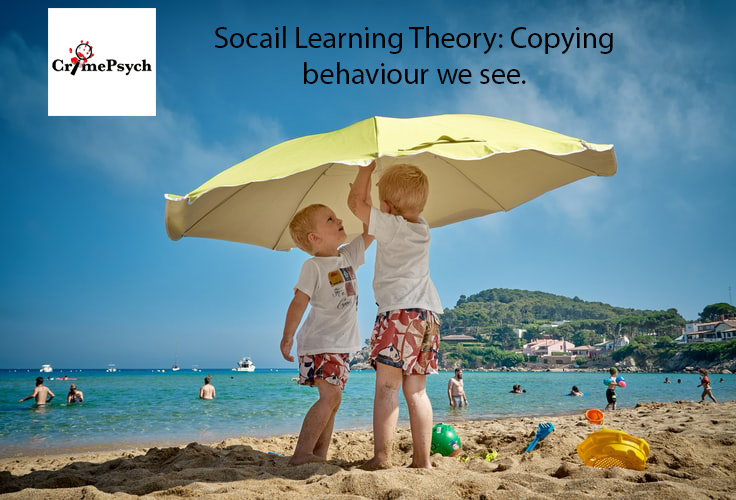
Last week’s blog looked at Operant conditioning and how we learn through positive and negative reinforcement. However, over time psychologists build upon other people’s ideas and suggest improvements. Some psychologists will completely agree with others ideas and build upon them. Others will completely disagree and suggest vastly different processes.
We know that we can learn in various ways. We do not learn by reinforcement of behaviour alone. A psychologist named Albert Bandura agrees with behaviourist learning theories. Investigative psychologists take well known and well-established principles from within all areas of psychology and apply them to crime and criminal activity.
In social learning theory, Albert Bandura agrees that we learn through classical and operant conditioning. However, he adds that there is a mediating process which occurs between the stimulus and response. Secondly, he proposes that behaviour is learned through observation of others.
This was demonstrated in his famous experiment using the Bobo doll in 1961. This study was based on aggression. Adults verbally or physically abused an inflatable doll in front of pre-school age children. The children later mimicked the behaviour of the adults towards the inflatable doll. There were control groups who observed caring behaviour being displayed by the adults and they also later copied them.
This series of experiments showed that children learn from the people around them. They learn from teachers, siblings, parents, children’s TV characters, pop stars and so on. These people provide examples of behaviour to observe and imitate. The children pay attention to those around them and later copy what they have seen.
Children do this to all types of behaviour regardless of whether they are gender appropriate. However, certain factors make it more likely that behaviour will be replicated. For example, if the child sees someone similar to them in some way, they are more likely to replicate the behaviour. For example, if a group of girls are play fighting and a group of boys are having a tea party, the child is more likely to copy the girls as they share a similarity.
The second process that makes it more likely that a child will repeat a behaviour it has observed is whether they are rewarded or punished. If the girls were chastised for they play fighting they are less likely to do it again. If the boys were rewarded for having a tea party they are more likely to do it again. Each time the behaviour is rewarded, the behaviours are reinforced.
The children watch others to see what happens after they have completed a behaviour to see what happens next before they decide to copy them. For example, if a child watches another child put toys away and is rewarded, then the second child will copy and also put toys away. This is known as vicarious reinforcement or vicarious learning.
Children will have several people that they watch and copy. This may be their family or friends. However, it can also be fantasy characters or people in the media. The motivation to identify with a particular person could be because they have a property the person wishes they had.
Unlike Skinner, Bandura believes that humans are active information processors and think about the relationship between their behaviour and its consequences. Bandura suggests that people do not learn simply through this observation, but think about behaviour before they imitate it. He proposes that observational learning cannot occur without this cognitive process.
4 main factors mediate the relationship between observation and learning. The first is attention. For behaviour to be imitated, it must first catch our attention. There are hundreds of behaviours that people see each day and we don’t copy them all. Attention is therefore extremely important in whether a behaviour is imitated.
The second factor is retention, in other words, how well we remember it. We must form a memory of the behaviour so that we can perform it later. Social learning is not always immediate; we do not always copy behaviour straight away. Therefore, we need a memory of it to recall later.
The third factor is reproduction. We must physically able to imitate the behaviour. Just because we see someone doing a high jump and want to copy them doesn’t always mean that we are going to bale to. This influences our decisions whether to try and imitate it or not.
The final factor is motivation. We consider the rewards and punishments of imitating particular behaviours before we copy them. If the benefits outweigh the cost then we are more likely to imitate behaviour. Similarly, if the punishment outweighs the reward then we are not likely to imitate.
In conclusion, we learn through watching other people. Although we do have an active cognitive process in this. We are more likely to copy behaviour that is performed by people we see as similar to us in some way. We think about the costs and benefits of imitating behaviours, we do not blindly copy others. Therefore, if a person has criminal friends or family members, it is more likely that they will imitate that behaviour.

by CrimePsych | Feb 7, 2020 | Blog
In years gone by we would sign up for a course at school or college if we wanted to learn something new. With the advancements of the internet, learning new subjects is now much more accessible and convenient. There are many advantages to learning online, so below are 10 key benefits.
- It is convenient and flexible.
Most online courses are available whenever you are. Students can access their course at a time that is convenient for them. This makes it much easier to fit studying in around your work schedule. Of, if you are anything like me and have children, finding a quiet 10 minutes during the day is impossible! We all tend to carry around devices which connect to the internet which means that you could take your course on the morning commute to work (as long as you’re not driving that is!)
- You can learn the same thing as many times as you need.
If you don’t fully understand or absorb the information the first time around, you can repeat it as many times as you need to. You could even watch it again with other people to discuss the subject for a deeper understanding of it.
- There is a large range of subjects available.
There are thousands of new subjects that you can learn. There are also many different levels of education available online. You can choose from a very general overview of a subject up to university undergraduate and postgraduate levels.
- You have control over how fast or how slow you learn.
You can take as much time as you need to understand the new subject. Similarly, if you are a fast learner you can complete it quickly without having to wait for others to catch up. One of the benefits of online learning is that you do not have to sit for long periods if you don’t want to. I am sure most people reading this have binge-watched a series on Netflix or other providers. Now you can do the same with your learning – become knowledgeable about a subject over the weekend!
- Learning online is much less intimidating than going to a classroom.
You may be shy or feel a little intimidated by going to a classroom. I know I felt as though I was the most stupid person in the room when I first started college. However, having access to all of the information in a setting you feel most comfortable in can increase attention and ability to learn. Plus, it is much easier to ask questions online and you often get a quick response. If you don’t understand or want more information on something it may feel intimidating approaching another person. You may feel more comfortable talking openly with teachers through online methods rather than face to face. Being able to contact a teacher online also means you can ask the questions any time, you don’t have to wait until office hours.
- It is often cheaper to learn online.
There are much fewer overheads to cover hen a course is delivered online. This means that the courses can be offered at a much lower price. Learning online also means that it will cost you less in transport getting to and from your course. It also eliminates the need for time off work, babysitters, or other expenses involved in classroom learning.
- You can learn from millions of providers around the world.
This means that distance learning is easier than ever before. It gives you a wider range of courses and instructors to learn from. Fortunately for you, this also means that they will be competing in price and will offer their course as cheap as possible. Imagine sitting on a beach in an exotic location sipping a cold drink and learning something new or gaining a qualification!
- Learning online is eco-friendly.
When you learn online, you have all your resources available at the touch of a button. This eliminates the need for printed books and paper, thus reducing waste. The added benefit of learning online is that you do not have to travel which means reduced emissions. Learning online means we can reduce our carbon footprint.
- Earn recognised diplomas and qualifications.
Many online courses will offer the opportunity to earn a recognised award from a regulating body. These awards and diplomas are officially recognised in workplaces and institutions around the world. These new qualifications could make a massive difference in gaining employment and gaining promotions.
- Chat and communicate with others learning the same subject.
Many online learning providers have forums, groups and pages available online which means that students can connect. It would be unlikely for any physical location to have thousands of people learning the dame subject as you. However, with online chats and forums, you can enrich your knowledge and understanding by talking with others.
by CrimePsych | Jan 30, 2020 | Blog
Operant conditioning is a theory which is used to explain how we learn new behaviours. Operant conditioning is a method of learning that occurs through rewards and punishments for behaviour. Through operant conditioning, an individual makes an association between a particular behaviour and a consequence. The theory was proposed by Skinner in 1938.
Learning through operant conditioning can be applied to criminal activity. Offenders can learn to become involved in crime in various ways.
Skinner is thought of as being the father of Operant Conditioning, but his work was based on Thorndike’s law of effect from 1898. According to this Thorndike, behaviours that are followed by pleasant consequences are likely to be repeated. Behaviours that are followed by unpleasant consequences are less likely to be repeated.
Skinner uses the term reinforcement in his theory of learning. Behaviour which is reinforced tends to be repeated. Behaviour which is not reinforced tends to die out-or be extinguished.
Like many psychologists, Skinner studied operant conditioning by conducting experiments using animals which he placed in a ‘Skinner Box’. Skinner identified three types of responses from external stimuli. The first is neutral. This is where responses from the environment neither increase nor decrease the probability of a behaviour being repeated. The second is reinforces. These are r Responses from the environment that increase the probability of a behaviour being repeated. Reinforcers can be either positive or negative. The third is Punisher responses. These are responses from the environment that decrease the likelihood of a behaviour being repeated. Punishment weakens behaviour.
We can all think of examples of how our behaviour has been affected by reinforcers and punishers. As a child, you probably tried out many behaviours and learned from their consequences.
For example, if you tried smoking at school, and the consequence was that you got in with the crowd you always wanted to hang out with, and you would have been positively reinforced and would be likely to repeat the behaviour. In other words, the behaviour would have been rewarded. If, however, the main consequence was that you were caught, and your parents became involved you would likely to have been punished, and you would then be much less likely to smoke now.
Reinforcement of behaviours can be positive or negative. Positive reinforcement strengthens a behaviour by providing a consequence an individual finds rewarding. For example, if your parents gave you £5 each time you complete your chores you will be more likely to repeat this behaviour in the future, and so strengthening the behaviour of completing your tasks.
Negative Reinforcement means that unpleasant consequences are removed and so strengthens behaviour. Negative reinforcement strengthens behaviour because it stops or removes an unpleasant experience. For example, if you do not complete your homework, you have to give your parents £5. You will complete your tasks to avoid paying £5, and so strengthens the behaviour of completing your homework.
This would be similar to you touching an electric fence and getting a shock. If you jumped and accidentally hit the off switch on the floor beside the fence, then next time you wanted to pass the fence you would go straight to the off switch.
Punishment weakens particular behaviours. Punishment is defined as the opposite of reinforcement since it is designed to weaken or eliminate a response rather than increase it. It is an aversive event that decreases the behaviour that it follows.
Like reinforcement, punishment can work either by directly applying an unpleasant stimulus like a shock after a response or by removing a potentially rewarding stimulus, for instance, deducting someone’s pocket money to punish undesirable behaviour. It is not always easy to distinguish between punishment and negative reinforcement.
There are some problems with using punishment though. For example, punished behaviour is not forgotten, it’s suppressed. The behaviour returns when punishment is no longer present. Punishments can cause increased aggression showing that aggression is a way of dealing with problems. Punishments do not necessarily guide the subject toward the desired behaviour – reinforcement tells you what to do, punishment only tells you what not to do.
We can learn new ways of doing things with the various reinforcers, but we can also forget or fail to keep up with the behaviour if the reinforcers are not present. This is response and extinction.
If an animal/human is positively reinforced every time a specific behaviour occurs, e.g., every time a lever is pressed a pellet is delivered, and then food delivery is shut off. The response rate is SLOW. The extinction rate is FAST. The animal or human is slow to learn and will quickly stop doing the new behaviour as soon as the reinforcer is taken away. A good example of this would be to ask you how many days you would go into work if they stopped paying you?
If a behaviour is reinforced only after the behaviour occurs a specified number of times. e.g., one reinforcement is given after every so many correct responses, e.g., after every 5th response. For example, a child receives a star for every five words spelt correctly. The response rate is FAST meaning they would learn it quickly. The extinction rate is MEDIUM meaning that they would carry on doing it for a little while to see if they get the reward.
If the behaviour was reinforced after a fixed time providing at least one correct response has been made. An example is being paid by the hour. Another example would be every 15 minutes (half-hour, hour, etc.) a pellet is delivered (providing at least one lever press has been made) then food delivery is shut off. The response rate is MEDIUM so it would take a little longer to learn the new behaviour. The extinction rate is MEDIUM meaning they would carry on for a moderate length of time to see if a reward was coming.
If a behaviour is reinforced after an unpredictable number of times. For example, gambling or fishing. The response rate is FAST meaning we pick up the new behaviour fairly quickly. The extinction rate is SLOW meaning that very hard to extinguish the new behaviour because they can’t predict when the reward or reinforce is coming.
Finally, if a reinforcer was given after an unpredictable length of time as long as one correct response or behaviour was done within that time. The response rate is FAST meaning we would be quick to complete the new behaviour. The extinction rate is SLOW meaning the behaviour would carry on for a substantial length of time because of the unpredictability of the reinforcement.
Changing behaviour or building new behaviours takes time. Reinforcement or punishments need to be used consistently over a prolonged period.


