
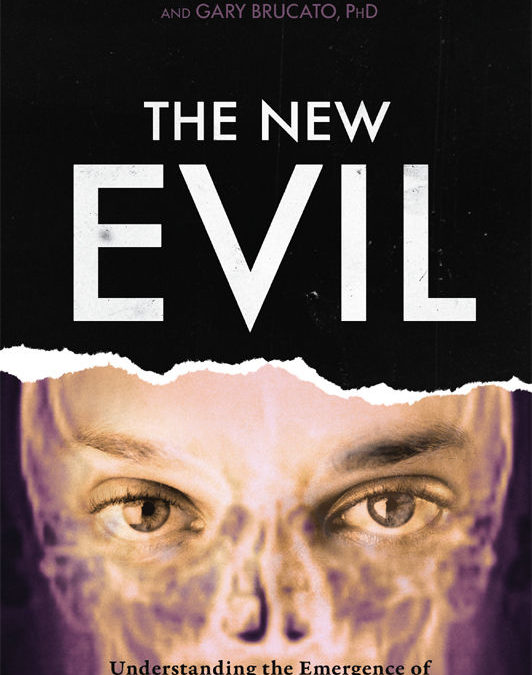
Book review: The New Evil.
When I was first asked to review this book I was a bit sceptical about it. This was mainly because I thought of the term ‘evil’ as problematic. The word ‘evil’ is very subjective and the definition of it can depend on context, societal values, moral values and so on. For me, the word evil has religious connotations. So for this book to claim it had produced a classification system to define how evil an act was a bit odd, or so I thought. I even said to the author ‘I find the idea of ‘evil’ interesting. It is a word that is used a lot, but makes no sense when used alongside psychiatric conditions.’ But Dr Brucato was confident about his work and asked if I’d read it anyway.
Despite being sceptical I read it anyway and was immediately proved wrong. As a researcher, I’m always open to constructive criticism and am willing to change my views. From the very onset, the authors brilliantly define what they mean when they talk about ‘evil’. There are several pages outlining what they mean when they talk about evil. They are also careful to outline what they do not mean as evil. They focus on the acts some people have committed rather than the person themselves. As I have come to realise myself, offenders can have loving and caring relationships and can operate well in some areas of their lives. I once had a lengthy conversation with a gentleman about human rights and we had similar views about this. After that, I found out that he had a violent past which resulted resulting in him killing another man.
Unlike similar books I have read, the authors acknowledge the depraved nature of killers rather than sensationalise their acts. They pause to pay their respects to the victims. The media often reports on violent offenders and gives background details of the offender. Often, little attention is given to the victims. Within criminal psychology, the type of victim can often tell us a lot about the offender.
You could substitute the word ‘evil’ for violence, depraved acts, immoral behaviour and the scale would still work the same way and the book would be just as good. The Gradations of Evil Scale contains 22 categories which are on a continuum. Some acts of murder are not very evil and would be placed at number 1. Other acts of murder are described as being the worst kind of evil and would be placed at number 22.
According to Brucato & Stone, on the Gradations of Evil Scale murderous acts which are placed in categories 1 to 8 are those people who do not have any form of mental illness and are not psychopaths. These murders are committed for reasons such as abuse, impulsiveness, intense feelings of jealousy or anger, self-defence, or loyalty. The authors give detailed examples of actual cases that could be placed into various classifications. Actions which are placed in categories 9 to 22 require an ability to distinguish between psychopathy, narcissism, psychosis, and sadism. Even with someone with no prior knowledge would be able to follow the authors as they lead the reader through these categories. These acts would be committed to conceal evidence, for sport or sexual gratification and would be carried out without any compassion or guilt.
This book walks the line between giving accurate credible information that a professional could relate to, and is well written enough for a layperson to be able to read and enjoy. I have always thought of clinical psychologists being interested in the ‘whole person’. This book does just that, it gives detailed examples of the types of offender that each category has. However, applied psychologists (such as criminal psychologists) are more interested in identifiable and measurable behaviours or acts, which can be statistically tested in order to prove and define them. As I read, I found myself getting very excited about the possibility of testing their categories. I have since asked Dr Brucato if he would like to work with me to do this.
Besides the scale of evil, this book is an excellent source for those who want to learn more about personality disorders and the differences between psychosis, psychopathy, sadism, and narcissism. The book also discusses cultural changes over time and how these can have an impact on behaviour. It also gives some thought as to why rape, murder, and other types of violent behaviour have increased over time.
The book is not solely about the Gradations of evil, it gives insightful discussions into the various sub-sets of murder such as infanticide, women who kill, stalkers, school shooters. These chapters lead the reader through the various attributes and historical increase in their occurrence. As we know, there was a dramatic increase in violent and murder across America from the late 1960s. This is the very reason the FBI set up their Behavioural Science Unit at Quantico. The book discusses some of the possible causes for this ‘new’ evil which has evolved in modern times.
In conclusion, I went from being fairly sceptical about a book with claimed to categorise evil alongside psychiatric terms and personality traits to becoming completely enthralled and captivated by the book. The book is very well written; it was almost as though they knew the reader would think along certain lines and give an insightful opening chapter. It was interesting, engaging, detailed, and quite simply brilliant. I am looking forward to exploring and testing the Gradations of Evil empirically.


