

What is a psychological autopsy?
The seductions of crime
Many of my blogs and videos are written from the perspective of a criminal psychologist. As a researcher, I want to examine crime and criminal behaviour so I can understand or explain behaviour. Much of this is done by conducting large scale studies and categorising behaviour in various ways. Some of the work involves working out what the likely characteristics of offenders are.
I have said on many occasions in the past that criminals are not a unique subset of individuals. They are amongst us. They are our brothers and sisters, mothers and fathers and so on. I have also said that we need to focus on the actual behaviours and interactions between victims and offenders to understand the psychology of it. However, a researcher named Jack Katz proposes a very different theory of how we should examine crime.
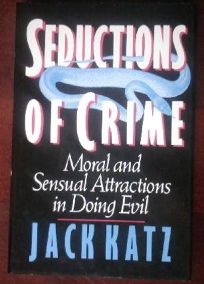
Katz wrote a book called the seductions of crime in 1988. It was and still is, seen as a fairly controversial view of criminality. Katz begins the book by asking the reader to reflect on the reasons they act in the way that they do, what propels them to act in certain ways in various contexts? He suggests it comes down to motivation. The invisible forces that attract us to interact or repel us away from interactions. For example, I went to visit my mother because I hadn’t seen her for a while. The underlying motivation to that is I wanted to make her happy which in turn made me happy and resulted in a pleasurable experience.
Similarly, I avoided going to the shops on Christmas eve because I knew it would be really busy and people might be bumping into one another and there wouldn’t be much left anyway. The underlying motivation here would be that I wanted to avoid an unpleasant stimulus by not going. This is the same reason I would not go and get involved in a fight.
Standard theories in criminology and psychology have attributed certain characteristics to offenders. For example, they come from a disadvantaged background, they were abused when they were younger, they have learned to react violently. However, if these are the only factors that cause criminality, then why are these people not committing crime every single minute of every single day? Katz suggests that there must be some underlying force that propels them to act when they do.
To put it simply, Katz suggests that offenders act ‘because they like it’. When talking about property crimes such as vandalism and burglary, Katz calls it the ‘Sneaky Thrill’. He suggests that these property crimes appeal to young offenders independent of the material gains that are made. One particular example he uses is of two young boys aged 14 and 16 driving around and spotting a pizza delivery driver. The older one said it would be so easy to steal those pizzas and they took them. They told how they spent no time thinking about it or discussing it, they weren’t even hungry but enjoyed the pizza because of the way they had got it.
There are countless examples of crimes being committed because of enjoyment. Often young people will break into a property and take items which are of little or no use to them. These items are sometimes discarded and are sometimes kept as souvenirs. They didn’t break in and take the goods because they wanted them or needed them, they simply broke in because it was exciting and stimulating.
Think of when you were a child and one of your parents told you that you were not allowed a particular treat. If the other parent sneaks it to you and says you can have it, it normally tastes so much better because you were told you couldn’t have it.
I have spoken in the past about the escalation in violence in serial killers. At first, only a minor act would be enough to cause excitement. For example, if a murderer strangled a victim to death they may find it highly stimulating and they would produce high levels of adrenaline. As the offender kills more victims, he needs a higher level of stimulation to get the same level of adrenaline and might be more violent with the victim.
The view that offenders commit crimes because of the excitement or enjoyment they gain from it may be controversial. However, it is understandable that please can drive people to act in this way. In the same way that pleasure can sometimes drive criminal behaviour, so to can the avoidance of negative consequences. Young people who vandalise or break into properties may be avoiding being bored.
I have seen this behaviour from a very personal point of view. I once knew a fairly wealthy middle-aged woman who used to go and do her shopping and steal some of it. She paid for some items and stole others. She used to tell me that she found it very exciting and it wasn’t about the items that she stole, but about the excitement and the fear of getting caught.
In a large scale study that I conducted with the general public some years back, one of the items on the questionnaire was ‘have you ever had sex outdoors?’ People often scored the highest on this particular item. I discovered that 68% of 225 people had sex outdoors on at least one occasion. Again, this is likely to be because of the excitement of getting caught.
In conclusion, I do not think that people commit crimes solely based on gaining pleasure or avoiding negative impacts. However, I do think that it can explain some of the motivating factors to offending. Obviously, most of us live by social norms and limit the things we do because they are against the law. Some people are more likely to live by social norms and follow the law than others. I believe the pleasurable aspects of offending certainly influence some individuals.

I swapped my motorbike for a keyboard

The psychology of violence
Violence can occur in many ways under a variety of circumstances. Violence can have a huge impact on a wide variety of people. The act of violence stems from the emotion of anger. Everyone experiences a range of emotions from happy and excited to sad and angry, it is part of our biological makeup. However, when the emotion causes us to behave in anti-social ways, we need to understand what drives it and how we can intervene to reduce or prevent it.
The act of violence can be a range of behaviours which stem from emotions and reactions to various stimuli. Psychologists have suggested that acts of violence can be explained as being an extreme response to a normal emotion. This can happen with a range of emotions. For example, everyone feels sad at times but only some develop depression. We all feel angry at times but not everyone resorts to aggression.
However, it is not as simple as this. Because if this were the case, then anger management programs would be 100% effective and they aren’t.
Anger may play an important role in violent behaviour for some. However, it is not necessary or sufficient on its own to cause violence. Other factors such as drug use and mental health problems have been linked to acts of violence. However, there is little evidence to suggest that these things cause violent behaviour. For example, fights at football matches can occur between rival fans, but some people have no interest in the team that attend matches so they can be a part of the violence. They are not angry at the time, not all will be on drugs or have mental health issues. They simply enjoy being violent.
It is unsurprising then, that rehabilitation programs and anger management programs are not 100% effective. Research has established that the most accurate predictors of violent behaviour are gender, age, and a history of involvement in violent acts.
Psychological research has established that there are two types of aggression: Instrumental or Expressive. It was Feshbach who coined these terms in his studies of aggression. Feshbach suggested that Instrumental aggression is defined as the violent act being carried out as a means of achieving something or getting an item. For example, if a thief punched a shopkeeper in the face to steal money from the till or goods, then the act was carried out so that they could achieve another aim. Alternatively, Expressive aggression is driven by emotion and the violent act is carried out as an emotional reaction. For example, if someone batters their partner because they are angry then the violence was the main aim of the act.
Several theories within psychology suggest that we learn how to behave through our experiences. By learning throughout our lives, we develop ways of interpreting and understanding the world and social processes. We have learned things as a young child such as our mother will protect us and feed us. As we grow we learn the positive and negative consequences of our actions. For example, a child might learn that if we kick the dog, their toys are taken away as a punishment or they get shouted at. The same principle can be applied to violence. For example, a person may have learned that when they feel angry and are aggressive to someone it makes the feeling go away. They might learn that if they need money or want an item, they just have to use violence on a person to get it.
This process can be highly dependent on the individual contexts people come into contact with. However, some research has begun to explore what factors can trigger acts of violence. Research with high-risk, violent offenders indicates that low self-esteem, developed from a young age, can play a key role in triggering violent behaviour. For example, a person may have a negative view of themselves and have low self-esteem following a difficult, traumatic, abusive or neglectful childhood. This person may appear confident, even arrogant to other people. Researchers suggest that this is a defence against inward feelings of shame, weakness, vulnerability and inadequacy.
The research in this area has suggested that these feelings are so painful, that if the individual perceives that someone humiliates them or shows them disrespect, they are unable to tolerate it. A violent response restores a sense of self-worth and pride, while also punishing whoever caused that sense of injury or humiliation. It is not yet well established whether this assumption is true across a range of offenders, however, early indicators are hopeful.
As well as psychological explanations of violence, biological explanations also exist. Early in our evolution, violence and aggression have been important in keeping us safe and killing prey to eat. If a person shoots a man, it is a violent crime. However, if a hunter shoots an animal it is survival. It is the same act of shooting. As a species, we have developed a fight or flight response. Our brain shuts down normal functions and reverts to using the sympathetic nervous system. It happens very fast and is beyond our conscious control. We get massive doses of adrenaline and noradrenaline which change our body to prepare to fight for your life. Therefore, if a person feels threatened by real or imagined people, places, or things the automatic process takes over and can result in violence.
Hormones have also previously been suggested to increased acts of violence. Specifically, the hormone testosterone. However, research in this area now accepts that it is not testosterone in isolation that triggers aggression. Increased levels of testosterone have an impact on the amygdala, hypothalamus and periaqueductal grey and can increase aggression levels.
In conclusion, then, research in different areas has shown that several factors can increase aggression and as such impact on violent behaviour. However, it is most likely that aggression and violence are the results of an amalgamation of factors creating the ‘perfect storm’.


