

Why do we love true crime so much?
In modern times, we are obsessed with true crime. There are hundreds and thousands of books, blogs, podcasts, and vlogs on the subject. There are also hundreds of true crime documentaries as well as fictional accounts. We seem to be an ever-increasing audience hungry for anything true crime-related.
It was a fictional film portrayal of an FBI profiler that first sparked my interest in the field. After watching the silence of the lambs, I was enthralled with profilers and the FBI. I am not alone in this interest; I am a part of many online communities that have the same interests as me. There seems to be an ever-increasing audience for true crime output of all kinds. There are also ever-increasing numbers of content makers who are willing to fuel this interest, myself included.
Around half of my friends do not want to know about real-life cases, and the other half wants every last little detail. It is normal to a point to have an interest in true crime. There are many possible explanations for our interest in true crime.
Could it be that the fight between good versus evil fascinate us?
Have you ever driven past a particularly nasty accident and felt compelled to look even though we know it will be shocking to see? We know that the contents and details of these true crime events are not going to be pleasant, but we are drawn wanting to know the details. There could be several psychological mechanisms behind this. Several other blogs have also explored this. For example, the blog on shhhinsidevoice.com notes that it is an inherent need to understand the struggle between good and evil. (https://shhhinsidevoice.com/?p=1794)
Could our interest be fuelled by a need to keep ourselves safe?
Most people in our communities would never commit crimes such as murder. We have evolved from being in small tribes into much larger communities and societies. It benefits us to be able to trust each other within these communities and societies. Therefore, when someone commits a horrific crime, we are concerned for our safety.
Investigative journalist Caitlin Rother told Hopes and Fears “I think people wonder what motivates another person to commit such horrible acts against another, often a “loved one,” because we can’t fathom doing such things ourselves. We want some insight into the psychology of a killer, partly so we can learn how to protect our families and ourselves, but also because we are simply fascinated by aberrant behaviour and the many paths that twisted perceptions can take. It’s like not being able to stop watching a traffic collision that you know is about to happen. It grips your attention and you can’t look away. http://www.hopesandfears.com/hopes/now/question/216997-why-are-people-obsessed-with-true-crime
Are we just armchair detectives?
With the vast amount of coverage there is on crime, especially serial killings and murder, we see and hear inputs from lots of leading ‘experts’ in the case. Many of these cases raise more questions than they answer. These cases can leave us wondering who the perpetrator is, or if they have caught the right person. Take for example the recent hit series on Netflix ‘The Tiger King’. We know that Joe exotic is guilty of threats to kill Carole Baskin. However, it raised questions about Carole Baskins husband and insinuated that she may have killed him and fed her to the tigers. Another popular show was Making a Murderer on Netflix. That program raised questions of how culpable the suspects were and what evidence that they had.
A psychologist, Dr Arroll, told the Telegraph “I think the ones that are the most popular do leave some of that up to your imagination”. She went on to say “That is what good storytelling does. Because, although these are based on real-life cases, they are storytelling. They’re very well edited, and very well put together.” https://www.telegraph.co.uk/tv/a-confession/why-do-we-love-true-crime/
Do we just like being scared?
I know I do. I enjoy the feeling of being on a rollercoaster feeling scared of when the drop is coming but knowing that I am not likely to be hurt in any way. I enjoy watching horror movies for the same reason; I like being scared and wondering what is going to happen next and enjoy the adrenaline rush that comes from the jump scares. However, I would never want to be in a position where my life was actually at risk.
One of my favourite ways to unwind at the end of a stressful day is to cuddle up on the sofa and get my heart racing. I enjoy being able to work out who the most likely perpetrator is. Professor of criminology at Drew University Scott Bonn said in his book that true crime “triggers the most basic and powerful emotion in all of us– fear”. I know that I can experience fear in a controlled environment without ever putting myself at risk. https://backtracks.fm/blog/heres-why-people-love-true-crime-podcasts/#:~:text=According%20to%20Scott%20Bonn%2C%20professor%20of%20criminology%20at,of%20true%20crime%20novels%2C%20television%20shows%2C%20and%20podcasts.
Why does true crime draw more women than men?
The majority of those who seek out true crime stories are female. A social psychologist called Vicary did some initial investigations and found that men were more likely to read and review books about war, while the true crime books were more reviewed by women.
She delved further into the subject and found that “Compared to men, women liked reading about the psychological content of true crime stories,” Vicary said. “Stories where a killer was interviewed by an FBI profile, or that you’re trying to get to the inner workings of a killer in some way.” Women, she found, were also more likely to read true crime books if the victim in the story was female. “My conclusion was that women all seemed to like reading about survival, whether it was preventing or surviving a crime,” says Vicary. “Research shows that women fear crime more than men since they’re more likely to be a victim of one. My thinking is that this fear is leading women, even subconsciously, to be interested in true crime, because they want to learn how to prevent it.” https://www.forbes.com/sites/sarahwatts/2019/02/28/what-one-researcher-discovered-about-americas-true-crime-obsession/#53eccca95e6e
In conclusion, there are likely to be several reasons that we show an interest in true crime stories. These are likely to be different for everyone. One thing for sure is that true crime shows, documentaries, blogs, vlogs and podcasts are not going away any time soon. If you would like to hear more of my thoughts on the subject, have a listen to a podcast debate I took part in. https://soundcloud.com/sian-mcguinness-26613985/why-do-women-love-true-crime-podcasts-1?fbclid=IwAR1fPCrUXyFZmM2Dt6wsSH4FUePdFY9X4Yebf6e9H3DTldgEGU2Qi8KkgvI

The psychology behind anti or pro-mask wearing
The whole world is in crisis right now. We are experiencing a global pandemic of COVID-19 and economic uncertainty. We are all feeling fearful of what the future might look like. All of my social media pages are filled with conflicting information and people arguing over one issue or another. Therefore, I decided to make this blog to explore how psychology is in action throughout this process.
First of all, most of our reactions are brought about by emotion. We see, hear, or experience something and sometimes act or react based on how we are feeling. To use an extreme example, if I were fearful that I was going to catch COVID-19, and a person coughed close to me, I might react angrily. If, on the other hand, I had never heard of COVID-19 and a person coughed near me, I might offer them a tissue or simply move away from them.
During the initial stages of the pandemic, the World Health Organisation said that masks were not effective and wearing them would not stop the spread of the disease. They then changed their advice and said that masks would help to prevent the spread by catching the water droplets from being in the air. Therefore, in England, the government had said that masks are compulsory in public places such as shops and public transport. There are not many people who are indifferent about wearing a mask or not. For the main part, you are an anti-masker or you vigilantly wear one wherever you go.
I have seen pictures and memes of people making light of the situation such as the following:
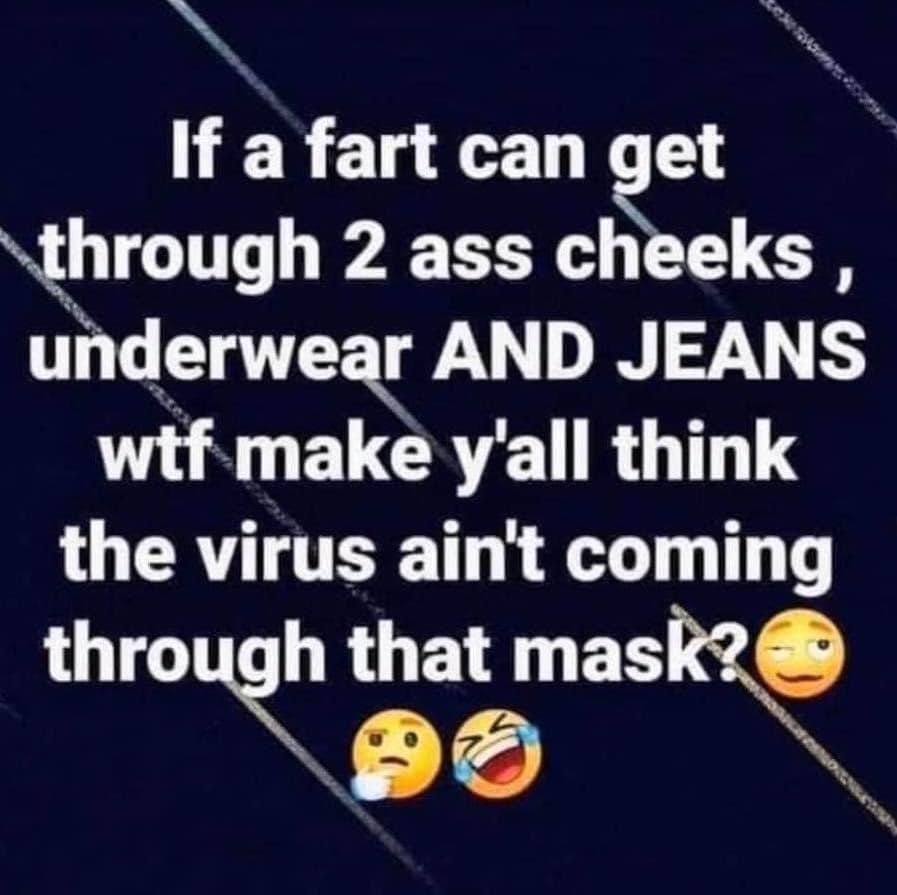
Or this:
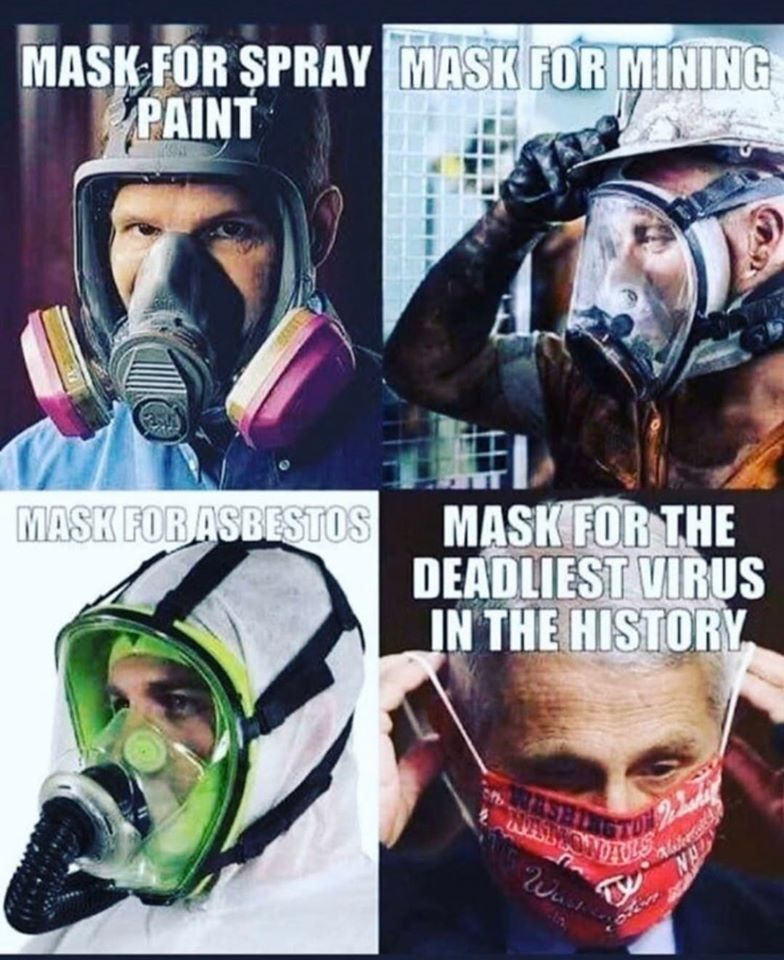
To help you to understand why this is happening, I am going to be drawing on several areas within psychology to discuss the great mask debate that people are having.
Within Social Psychology, a researcher called Henri Tajfel proposed Social Identity Theory. He suggested that we divide the world into “them” and “us” based a process of social categorization. We define these groups in several areas of our lives. For example, those who support one football team would define all of those who support the same team as ‘us’ and those who support the opposition as ‘them’.
We do this in many areas of our social life such as politics, work-life, religion, geography, family, and so on. Tajfel (1979) proposed that the groups which people belonged to were an important source of pride and self-esteem. Groups give us a sense of social identity: a sense of belonging to the social world. He proposed that it is based on a normal cognitive process: the tendency to group things. In doing so we tend to exaggerate:
1. the differences between groups
2. the similarities of things in the same group.
In the example of wearing a mask to stop the spread of COVID-19, if you believe that we should be wearing masks, those who also believe we should be wearing one are the ‘us’, or in-group. All of those who say masks are not necessary are ‘them’, or the out-group. The central hypothesis of social identity theory is that group members of an in-group will seek to find negative aspects of an out-group, thus enhancing their self-image.
In the debate of wearing a mask, this means that there are two groups of people highlighting the negative aspects of the other group. The mask wearers are saying to the non-mask wearers ‘you are being irresponsible by not wearing one and are putting lives at risk. The non-mask wearers are saying to the mask wearers ‘those masks are not effective and you are stupid for believing that’.
We are living in very uncertain times at the moment. Every aspect of our lives such as work, family, finances and future are in danger. When we are experiencing stress, we normally dig our heels in and refuse to change. When times and the future is uncertain, we are even less likely to change.
Human beings have a long history of learning to adapt. We learn from similar situations that have occurred in the past and make changes so that mistakes are not repeated. However, when we are feeling fearful, we are less likely to change our attitude or be willing to learn from past mistakes. In the current situation, we have many fears such as losing someone we love to the disease, fear that we may lose our jobs, fear that we will not be able to get another job, fear that the economy will deteriorate so badly that we may not have a pension to retire on. Fear that it may be a very long time before we return to “normal”.
This fear is very unhelpful within communities. If we are to be more resilient during these times, we need to manage this fear and become more flexible. We are going to need to adapt to a new way of living which will require us to be flexible.
In general, within society, we like people who are similar to us in some way. Meeting people who share our attitudes makes us feel more confident in our attitudes about the world. We feel comfortable and confident with people we trust and it gives us pleasure to have some control over our lives. This is why we separate the world into us and them. Pioneers in social psychology such as Allport (1968) say that the thoughts, feelings, and behaviours of individuals are influenced by the actual or implied presence of others. Our lives, more specifically, our social lives, are characterised by ‘norms’ (normal social similarities and differences between people, Turner, 1991).
We know that law and order must be followed so we know what is acceptable and what isn’t. Studies such as those carried out by Milgram have proven that we tend to obey authority figures. Milgram infamously set up an experiment where participants were ordered to administer electric shocks. Obedience to authority is ingrained in us all from upbringing. People tend to obey orders from individuals, or groups of individuals if they recognize their authority as morally and/or legally right. This response to legitimate authority is learned in a variety of situations such as within the family, school, and workplace.
From this perspective, we are being told to wear a mask by authorities and are therefore likely to follow this request. However, they initially said that masks would not help to stop the spread of COVID-19. Those people who oppose wearing masks have been influenced in the same way but at an earlier time.
Each group is seeking evidence to support their claim. The more we are exposed to a particular argument or suggestion the more likely we may be to be influenced to think the same. Within social media networks, we know that information will probably be accepted as true of enough people repeatedly mention it, even if the information is unfounded. Also, people tend to change their thoughts or habits by taking advice from their friends. (Christakis & Fowler, 2007)
There are arguments amongst friends, families, and within communities during these uncertain times. It is becoming the new normal to challenge strangers for not wearing a mask. This is fuelled by the lies and divisiveness by politicians and world leaders.
This is how racism grows. This is how crowd violence evolves. This is how wars start. This is how we become less powerful to enact changes that want and need. By dividing one large group of people into smaller groups such as anti or pro-mask, the individual smaller groups are less powerful and influential. What you end up with are the rich and the poor, the upper-middle and lower classes, the whites and the blacks, the indigenous and immigrants. This is divide and conquer.
I would implore you to have more empathy and be more understanding of each other. Listen and try to have some empathy so you can respond rather than react. If we are to survive in these times we need to communicate, connect, and support one another.
Psychological analysis of Susan Smith


