

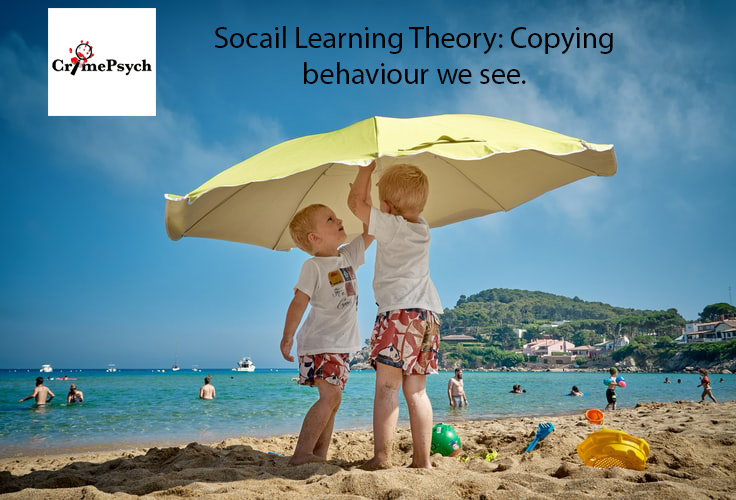
How we learn according to social learning theory
Learning with operant conditioning
Social Learning Theory: Copying what we see
Last week’s blog looked at Operant conditioning and how we learn through positive and negative reinforcement. However, over time psychologists build upon other people’s ideas and suggest improvements. Some psychologists will completely agree with others ideas and build upon them. Others will completely disagree and suggest vastly different processes.
We know that we can learn in various ways. We do not learn by reinforcement of behaviour alone. A psychologist named Albert Bandura agrees with behaviourist learning theories. Investigative psychologists take well known and well-established principles from within all areas of psychology and apply them to crime and criminal activity.
In social learning theory, Albert Bandura agrees that we learn through classical and operant conditioning. However, he adds that there is a mediating process which occurs between the stimulus and response. Secondly, he proposes that behaviour is learned through observation of others.
This was demonstrated in his famous experiment using the Bobo doll in 1961. This study was based on aggression. Adults verbally or physically abused an inflatable doll in front of pre-school age children. The children later mimicked the behaviour of the adults towards the inflatable doll. There were control groups who observed caring behaviour being displayed by the adults and they also later copied them.
This series of experiments showed that children learn from the people around them. They learn from teachers, siblings, parents, children’s TV characters, pop stars and so on. These people provide examples of behaviour to observe and imitate. The children pay attention to those around them and later copy what they have seen.
Children do this to all types of behaviour regardless of whether they are gender appropriate. However, certain factors make it more likely that behaviour will be replicated. For example, if the child sees someone similar to them in some way, they are more likely to replicate the behaviour. For example, if a group of girls are play fighting and a group of boys are having a tea party, the child is more likely to copy the girls as they share a similarity.
The second process that makes it more likely that a child will repeat a behaviour it has observed is whether they are rewarded or punished. If the girls were chastised for they play fighting they are less likely to do it again. If the boys were rewarded for having a tea party they are more likely to do it again. Each time the behaviour is rewarded, the behaviours are reinforced.
The children watch others to see what happens after they have completed a behaviour to see what happens next before they decide to copy them. For example, if a child watches another child put toys away and is rewarded, then the second child will copy and also put toys away. This is known as vicarious reinforcement or vicarious learning.
Children will have several people that they watch and copy. This may be their family or friends. However, it can also be fantasy characters or people in the media. The motivation to identify with a particular person could be because they have a property the person wishes they had.
Unlike Skinner, Bandura believes that humans are active information processors and think about the relationship between their behaviour and its consequences. Bandura suggests that people do not learn simply through this observation, but think about behaviour before they imitate it. He proposes that observational learning cannot occur without this cognitive process.
4 main factors mediate the relationship between observation and learning. The first is attention. For behaviour to be imitated, it must first catch our attention. There are hundreds of behaviours that people see each day and we don’t copy them all. Attention is therefore extremely important in whether a behaviour is imitated.
The second factor is retention, in other words, how well we remember it. We must form a memory of the behaviour so that we can perform it later. Social learning is not always immediate; we do not always copy behaviour straight away. Therefore, we need a memory of it to recall later.
The third factor is reproduction. We must physically able to imitate the behaviour. Just because we see someone doing a high jump and want to copy them doesn’t always mean that we are going to bale to. This influences our decisions whether to try and imitate it or not.
The final factor is motivation. We consider the rewards and punishments of imitating particular behaviours before we copy them. If the benefits outweigh the cost then we are more likely to imitate behaviour. Similarly, if the punishment outweighs the reward then we are not likely to imitate.
In conclusion, we learn through watching other people. Although we do have an active cognitive process in this. We are more likely to copy behaviour that is performed by people we see as similar to us in some way. We think about the costs and benefits of imitating behaviours, we do not blindly copy others. Therefore, if a person has criminal friends or family members, it is more likely that they will imitate that behaviour.

Benefits of online learning
In years gone by we would sign up for a course at school or college if we wanted to learn something new. With the advancements of the internet, learning new subjects is now much more accessible and convenient. There are many advantages to learning online, so below are 10 key benefits.
- It is convenient and flexible.
Most online courses are available whenever you are. Students can access their course at a time that is convenient for them. This makes it much easier to fit studying in around your work schedule. Of, if you are anything like me and have children, finding a quiet 10 minutes during the day is impossible! We all tend to carry around devices which connect to the internet which means that you could take your course on the morning commute to work (as long as you’re not driving that is!)
- You can learn the same thing as many times as you need.
If you don’t fully understand or absorb the information the first time around, you can repeat it as many times as you need to. You could even watch it again with other people to discuss the subject for a deeper understanding of it.
- There is a large range of subjects available.
There are thousands of new subjects that you can learn. There are also many different levels of education available online. You can choose from a very general overview of a subject up to university undergraduate and postgraduate levels.
- You have control over how fast or how slow you learn.
You can take as much time as you need to understand the new subject. Similarly, if you are a fast learner you can complete it quickly without having to wait for others to catch up. One of the benefits of online learning is that you do not have to sit for long periods if you don’t want to. I am sure most people reading this have binge-watched a series on Netflix or other providers. Now you can do the same with your learning – become knowledgeable about a subject over the weekend!
- Learning online is much less intimidating than going to a classroom.
You may be shy or feel a little intimidated by going to a classroom. I know I felt as though I was the most stupid person in the room when I first started college. However, having access to all of the information in a setting you feel most comfortable in can increase attention and ability to learn. Plus, it is much easier to ask questions online and you often get a quick response. If you don’t understand or want more information on something it may feel intimidating approaching another person. You may feel more comfortable talking openly with teachers through online methods rather than face to face. Being able to contact a teacher online also means you can ask the questions any time, you don’t have to wait until office hours.
- It is often cheaper to learn online.
There are much fewer overheads to cover hen a course is delivered online. This means that the courses can be offered at a much lower price. Learning online also means that it will cost you less in transport getting to and from your course. It also eliminates the need for time off work, babysitters, or other expenses involved in classroom learning.
- You can learn from millions of providers around the world.
This means that distance learning is easier than ever before. It gives you a wider range of courses and instructors to learn from. Fortunately for you, this also means that they will be competing in price and will offer their course as cheap as possible. Imagine sitting on a beach in an exotic location sipping a cold drink and learning something new or gaining a qualification!
- Learning online is eco-friendly.
When you learn online, you have all your resources available at the touch of a button. This eliminates the need for printed books and paper, thus reducing waste. The added benefit of learning online is that you do not have to travel which means reduced emissions. Learning online means we can reduce our carbon footprint.
- Earn recognised diplomas and qualifications.
Many online courses will offer the opportunity to earn a recognised award from a regulating body. These awards and diplomas are officially recognised in workplaces and institutions around the world. These new qualifications could make a massive difference in gaining employment and gaining promotions.
- Chat and communicate with others learning the same subject.
Many online learning providers have forums, groups and pages available online which means that students can connect. It would be unlikely for any physical location to have thousands of people learning the dame subject as you. However, with online chats and forums, you can enrich your knowledge and understanding by talking with others.


