
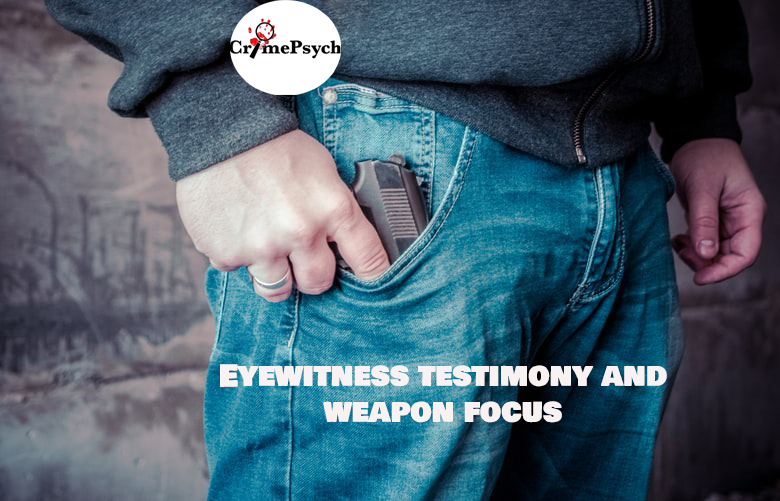
You will have heard the term eyewitness testimony before, but have you heard of weapon focus? An eyewitness is considered to be someone who has seen or hear a crime being committed. When the police are investigating a criminal act, they interview everyone who was in the area at the time to determine whether they saw or heard anything which may be of use in securing a prosecution.
Witnessing a crime can be a distressing event for some people, especially if it is violent or involves a weapon. Plus, psychological studies into memory show that we recall different types of information in different ways and this can cause inaccuracies and biases. People can make mistakes when trying to remember specific pieces of information. It is possible to remember whole events that did not happen.
Weapon focus is the concentration on a weapon by a witness of a crime and the subsequent inability to accurately remember other details of the crime. The presence of an unexpected weapon such as a gun or knife can impair the eyewitness’s memory for the perpetrator as well as other details of a criminal event. In other words, the eyewitness focuses so heavily on the weapon that they are not able to remember other details about the crime.
For example, you could be shown two pictures of a tennis court with a man holding one of two items. In the first picture, the man is holding a tennis racket. In the second picture, he is holding a gun. You would be able to tell me much more details about the scene when the man is holding a racket. That is because you would not expect to see a man holding a gun at a tennis match, but you would expect him to be holding the bat.
In normal day to day interactions, there is a lot of information available to us. It would be impossible to give our attention to every single bit of it. A simple 1 to 1 conversation produces a lot of information. We simply cannot process all of that information as fast as the person is talking to us.
Therefore, we have developed ways of attending to some types of information and not others. We use subconscious shortcuts to process the huge amount of information we receive. We use schemas to create shortcuts so that we don’t have to pay attention to every single piece of information. A schema is a cognitive framework or concept that helps organize and interpret information.
Schemas can be useful because they allow us to take shortcuts in interpreting the vast amount of information that is available in our environment. As experiences happen and new information is presented, new schemas are developed and old schemas are changed or modified. Schemas allow us to know what certain things are or how to act in various environments. For example, if we walked into a library we know that we are expected to be quiet. If a person comes in and is not quiet then we are more likely to pay attention to it because it is different.
We are also biased to some information and can take in some bits of information and ignore others. We might actively look or listen for certain pieces of information. We may not think some information will tell us anything and so ignore it. We create a simple set of rules of the types of things we should and shouldn’t look out for to tell when someone is lying. We then use these rules as mental shortcuts without even thinking about it.
These mental shortcuts are the processes that force our attention onto an unexpected weapon and remember fewer details about other aspects of the event.
There are many studies that have proven that the presence of an unexpected weapon reduces how accurately someone identifies the suspect or other details of the event. How much of a distraction the presence of a weapon causes has been found to vary according to the characteristics of the eyewitness, the scenario in which the weapon is encountered in and the procedure through which memory is tested. As a result, each of these factors (witness, scenario, testing procedure) must be considered prior to evaluating the risk of weapon focus for any given situation.
Large scale studies have proven that there is a greater focus on the weapon in situations judged to be threatening or arousing or involving criminal compared to non-criminal events. However, researchers have been unable to quantify the magnitude of these effects.


